UFC Prop Bets Guide for UK Punters: Specials, Exotics and How They Pay
 Available in US
The prop bet that hooked me on UFC specials was deceptively simple: “fight goes the distance — no” at 4/6 on a heavyweight bout. Both fighters had finishing power, the division’s knockout rate runs near 49%, and neither man had seen a judges’ decision in their last three outings. The “no” hit in the second round, and I collected a profit that the moneyline on either fighter couldn’t have matched at comparable risk. That’s the appeal of UFC props: they let you bet on how a fight unfolds rather than just who wins, and for bettors who analyse fights deeply, they unlock value that the moneyline can’t reach.
Prop bets — short for proposition bets, often called “specials” at UK bookmakers — cover everything from method of victory to specific fight-length outcomes to novelty markets that have no direct connection to the fighters’ skills. This guide catalogues what’s available, separates the serious from the silly, and shows you where genuine value hides in the prop market.
Common UFC Prop Bets at UK Bookmakers
“Fight goes the distance” is the most widely available UFC prop at UK bookmakers and, in my experience, the most consistently exploitable. The market offers a simple yes/no bet on whether the fight reaches the judges’ scorecards. Nearly half of all heavyweight bouts end by KO/TKO — 49% — while only 28.6% go to decision. In women’s strawweight, the dynamic inverts: just 13.4% of fights end by knockout, and 66.9% reach the scorecards. Those divisional disparities create systematic mispricings, because the “goes the distance” line is often set closer to the overall UFC average than to the division-specific reality.
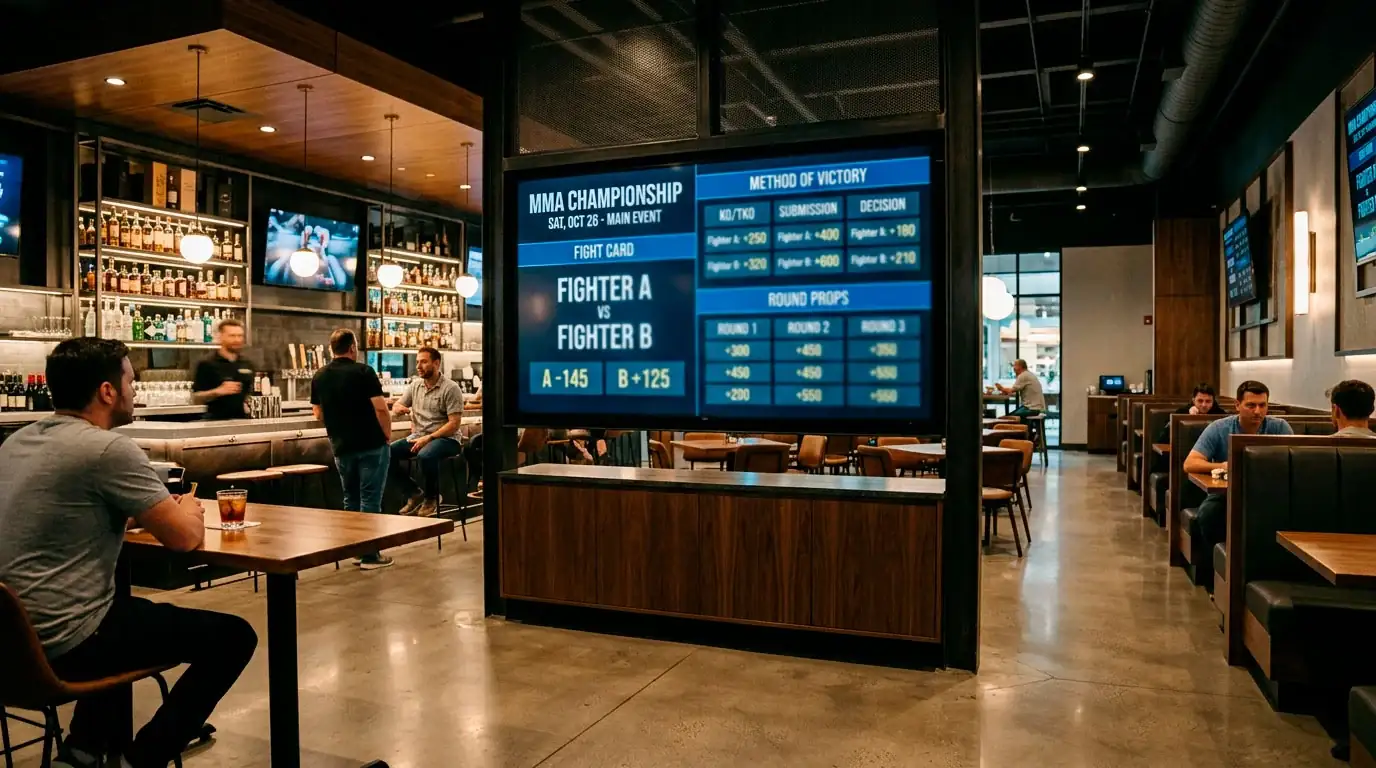
Method of victory props ask you to predict the specific way the fight ends: KO/TKO, submission, or decision (and sometimes split by fighter, creating six possible outcomes). The pricing on these markets reflects the bookmaker’s assessment of each method’s probability, and the margins are typically wider than on the moneyline — 8-12% overround compared to 5-8% on a two-way market. The wider margin means you need a more substantial edge to profit, but the additional specificity of the bet also means the bookmaker’s pricing is more likely to contain errors, particularly when fighter-specific tendencies don’t align with divisional averages.
Over/under rounds is technically a totals bet rather than a prop, but it functions similarly in the UFC context. The line is set at a specific round total (usually 1.5 or 2.5 for three-round fights, 2.5 or 3.5 for five-round bouts), and you bet on whether the fight will last longer or shorter than that number. The pricing closely tracks the “goes the distance” market but offers different value in certain configurations — a fight priced at over/under 1.5 rounds is a different proposition from over/under 2.5, even for the same bout, and the relative value on each line depends on where you believe the finish is most likely to occur.
Fighter-specific props — “Fighter A to win in round 1” or “Fighter B to win by submission” — combine a directional bet with a method or timing prediction. These are the highest-paying single-fight props and the hardest to hit consistently. The prices typically start at 3/1 or 4/1 for the most likely specific outcomes and can extend to 20/1 or beyond for improbable scenarios. The key is that these are not independent bets — the probability of Fighter A winning by first-round KO is conditional on both Fighter A winning and the fight being stopped by KO in round one — which makes the probability calculation more complex than it appears.
Exotic and Novelty Props
Beyond the standard offerings, some UK bookmakers venture into more creative prop territory for high-profile UFC events. “First blood” props (which fighter will draw first blood from a cut), “fighter to be knocked down” (regardless of who wins), and “fight to start round 3” are examples of niche markets that appear on major pay-per-view cards and occasionally on Fight Night main events.
Novelty props — bets on post-fight speeches, walkout song choices, or whether a specific fighter will call out an opponent after winning — exist primarily as entertainment and carry margins so wide that they’re rarely worth serious analytical attention. I place these bets with the same attitude I’d bring to buying a scratch card: the stake is trivial, the potential return is amusing, and the expected value is firmly negative. They’re fun, and that’s all they need to be.
The line between serious and entertainment props isn’t always clear. “Fighter to score a knockdown” might sound exotic, but it’s actually a well-defined outcome that can be analysed using striking data, power metrics, and opponent durability. “Fighter to touch gloves before round 1” is a novelty that no amount of analysis can predict reliably. Treat each prop on its merits: if you can construct a probability estimate from data, it’s a serious betting opportunity. If you can’t, it’s entertainment.
Finding Value in UFC Props
Mark Shapiro, TKO’s president, described 2025 as a year of record-setting live events and transformational partnerships — and that growth has expanded the range of prop markets available on UFC cards. More markets mean more pricing decisions by the bookmaker, and more pricing decisions mean more opportunities for errors that analytical bettors can exploit.
The most consistent source of prop value, in my experience, is the “goes the distance” market in fights where the divisional finish rate strongly favours one side. Heavyweight fights with two knockout artists should have a “goes the distance — no” line priced around 1/3 or shorter, but I regularly see it priced at 4/6 or even money, which implies a probability closer to 50-60% rather than the 70%+ that the divisional data supports. Women’s strawweight fights with two technical strikers should have “goes the distance — yes” priced aggressively, but the line often drifts toward even money or longer, creating value on the decision outcome.
Cross-referencing individual fighter finish rates with the divisional baseline is the core analytical technique. A fighter with a 70% finishing rate competing in a division where the average is 53% is a statistical anomaly whose bouts should be priced differently from the norm. If the props don’t reflect that anomaly — if the “goes the distance” line and the method of victory pricing treat this fighter’s bout as average — the mispricing is your edge.
In women’s strawweight, where 66.9% of bouts reach the judges, the decision method of victory line often carries the best value on the entire card. The market knows that decisions are the most common outcome in the division, but it frequently underprices the magnitude of that dominance. A method of victory bet on “decision” at 6/5 in a division where decisions occur two-thirds of the time is a simple, repeatable value play that doesn’t require any opinion about who wins — just an opinion about how the fight ends.
Prop parlays — combining multiple prop selections into an accumulator — amplify both the potential return and the bookmaker’s margin. I avoid them almost entirely for the same reasons I’m cautious with standard parlays: the compounding vig erodes the edge faster than the correlation between legs can rebuild it. The one exception is same-fight props where the legs are positively correlated (Fighter A to win and fight to not go the distance, in a fight where Fighter A is the heavier hitter), but even then, I stake these at a fraction of my standard unit and treat the broader range of UFC bet types as the primary toolkit.
Props as Precision Tools
UFC prop bets reward the bettor who does the deepest work. The moneyline answers a simple question — who wins? Props answer more complex questions — how do they win, when do they win, and what happens along the way? The specificity demands more analysis, but it also offers more opportunities for the market to be wrong. If you’ve built a detailed model of how a specific fight is likely to unfold, the prop market gives you the vehicles to express that model with surgical precision. Use them sparingly, analyse them rigorously, and treat the wider margins as the cost of access to a market where genuine edges are more common than on the heavily traded moneyline.
What are the most popular UFC prop bets at UK bookmakers?
The most widely available and popular UFC props at UK bookmakers are: fight goes the distance (yes/no), method of victory (KO/TKO, submission, or decision, sometimes split by fighter), and over/under rounds. High-profile events may also offer fighter-specific props such as ‘Fighter A to win in round 1’ or ‘fight to start round 3.’ These markets are typically available for main card fights, with more limited prop offerings on preliminary bouts.
Can I combine prop bets into an accumulator?
Yes, most UK bookmakers allow you to combine UFC prop bets from different fights into an accumulator. Some operators also offer same-fight bet builders that let you combine props from within a single bout, though the available combinations and correlation adjustments vary by platform. Be aware that combining props into an accumulator compounds the bookmaker’s margin across all legs, which means the effective house edge on a prop parlay is significantly higher than on the individual props placed separately.
Written by the editors at how Does ufc Betting Work.