UFC In-Play Betting Strategy: Round-by-Round Tactics for Live Wagers
 Available in US
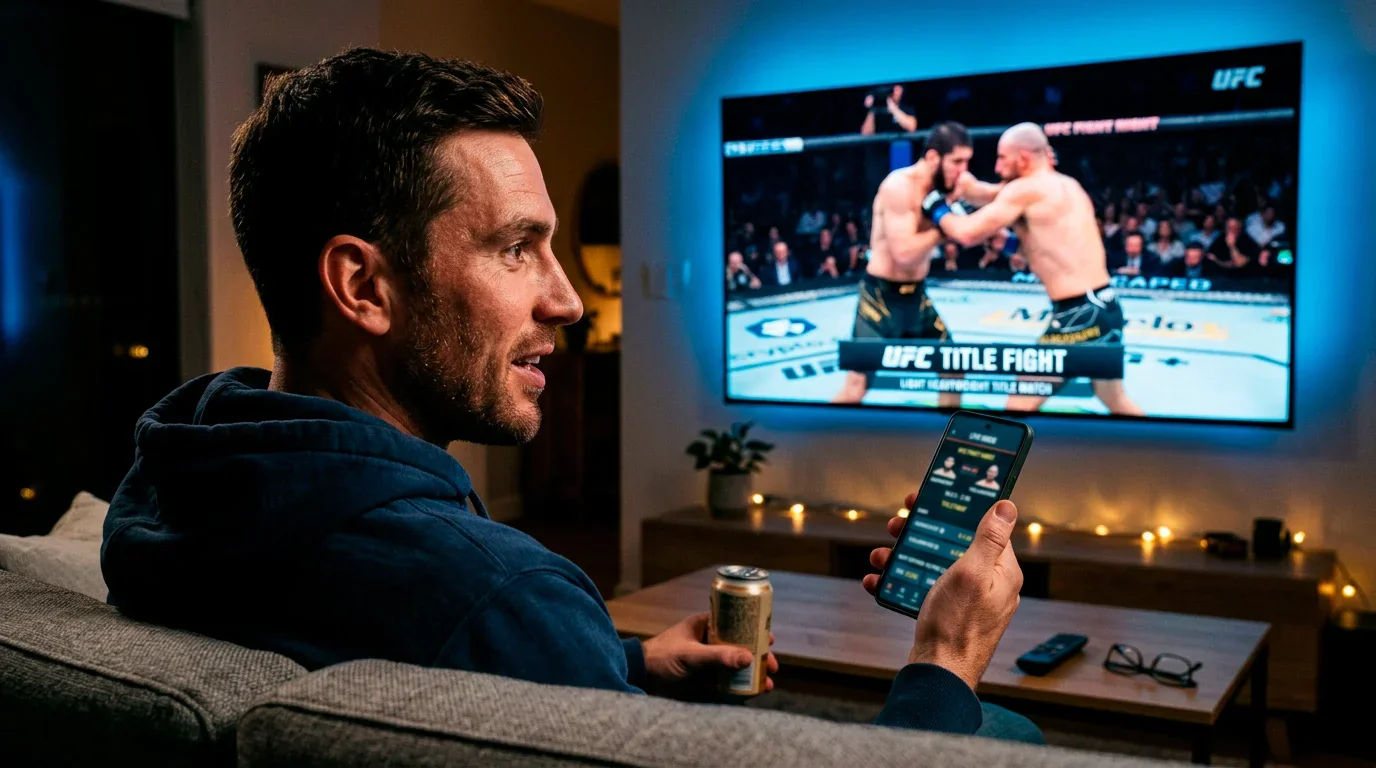
The smartest live bet I ever placed took me less than ten seconds to decide on. A heavy favourite had lost the first round clearly — outworked on the feet, taken down twice, visibly frustrated. His in-play odds drifted from 1/4 to even money. But I’d watched this fighter for years, and I knew two things the market was discounting: he always started slowly against southpaws, and his second-round output historically doubled his first-round numbers. I backed him at evens. He won by third-round TKO. The pre-fight odds had been right about who would win; the live odds had overreacted to a single bad round.
UFC live betting generates 11% of all live-bet clicks on major platforms during fight nights — a remarkable share for a sport that runs events roughly once a week. The appeal is obvious: you’re watching the fight unfold in real time, and the odds are adjusting to what you see. But live betting rewards a very specific skill set: the ability to separate what you’re seeing from what it means, and to act on that distinction before the market corrects itself.
Reading the Fight Live: What to Watch
The single most important skill in live UFC betting is distinguishing between damage and dominance. A fighter can win a round convincingly on the scorecards — landing more strikes, controlling the cage, securing a takedown — without actually hurting their opponent. Conversely, a fighter can lose a round on points but land the one clean shot that buckled their opponent’s legs for a moment. The in-play odds react to both scenarios similarly (the round winner’s odds shorten), but the predictive implications are completely different.
Damage accumulation is what ends fights. Dominance accumulation is what wins decisions. If you’re betting on a finish (method of victory, under rounds), look for genuine damage signs: wobbled legs, cut skin, heavy breathing through the mouth, dropped hands, retreating rather than circling. If you’re betting on the moneyline and the fight is heading toward a decision, look for dominance indicators: cage control, takedown success, striking volume, and which fighter is dictating the range and rhythm of the exchanges.
Roughly 45% of UFC bouts end by KO/TKO, which means nearly half of all fights produce a moment where the in-play odds should shift dramatically — and sometimes that moment arrives when the market hasn’t fully processed what just happened. A fighter who gets dropped but recovers cleanly may see their odds overreact to the knockdown, creating temporary value on their moneyline. A fighter who lands a body shot that visibly slows their opponent may not see the odds shift at all, because body damage is harder to spot on broadcast than a head snap or a knockdown.
Watch the corners between rounds. The instructions a fighter’s corner gives are audible on many broadcasts, and they tell you about the tactical adjustments coming in the next round. A corner telling their fighter to “stop reaching” and “work the jab” is making a technical correction. A corner telling their fighter to “dig deep” and “you need a finish” is acknowledging their fighter is behind on the scorecards and needs a dramatic shift. That information is available to everyone watching, but surprisingly few live bettors process it as a betting signal.
Betting at Round Transitions
The sixty-second break between rounds is the single most valuable window for live UFC bettors. The bookmaker’s algorithms update the in-play odds based on the completed round, fighters are briefly stationary (allowing visual assessment), and the market pauses just long enough for you to make a decision without the chaos of mid-round action.
My approach is to assess three things during the break. First: who won the round, and by how much? A close round that could be scored either way has different implications than a dominant round where one fighter was clearly superior. Second: are there signs of accumulating damage or fatigue that will carry into the next round? Swelling around the eyes, laboured breathing, and reduced movement speed all suggest a fighter whose condition is deteriorating. Third: does the tactical matchup favour a shift in the next round? A fighter who was taken down repeatedly in round one might adjust their stance and distance in round two; a fighter who was outworked on the feet might attempt more grappling in the next round.
Round transitions are also the best time to place over/under bets if the market is still offering them. If a fight has gone one round without serious damage and both fighters look comfortable, the probability of the fight going the distance has increased — but the over/under line may not have adjusted fully, especially if the pre-fight expectation was a finish. Similarly, if round one produced a knockdown and visible damage, the under becomes more attractive and the live price may lag behind the reality of what you’ve just watched.
Hedging and Cashing Out During a Fight
Nicholas Smith, UFC’s SVP of global partnerships, described bet365 as understanding “fight fans and how they engage with the sport in real time” — and one of the most sophisticated real-time engagements is knowing when to protect a position rather than let it ride.
Hedging a live UFC bet means placing a second bet on the opposite outcome to guarantee a profit regardless of the result. If you backed Fighter A pre-fight at 2/1 and Fighter A wins the first two rounds clearly, their in-play odds might shorten to 1/5. At that point, you could back Fighter B at the new, longer price. If Fighter A wins, your original bet pays; if Fighter B mounts a comeback, the hedge covers your loss and potentially delivers a profit on the second bet.
The decision to hedge should be mathematical, not emotional. Calculate the guaranteed profit from the hedge versus the potential profit from letting the original bet ride. If the guaranteed profit is close to the potential profit, hedging makes sense — you’re removing risk at minimal cost. If hedging would sacrifice most of your potential profit, letting it ride is often the better choice, provided your analysis of the remaining rounds supports the position.
Cash-out features at UK bookmakers offer a simpler version of hedging. The bookmaker calculates a cash-out value based on the current in-play odds and presents a single-click option to settle the bet early. The cash-out value is always slightly less than the theoretical hedge profit, because the bookmaker builds in a margin on the feature. But for convenience and speed — critical during a live UFC event where odds can shift in seconds — cash-out is a practical alternative to manually placing a hedge bet.
One scenario where I always consider hedging: when a fighter I’ve backed pre-fight at generous odds has clearly won the first three rounds of a five-round main event, but the opponent is known for late finishes. The scorecards favour my fighter, but the championship rounds carry elevated risk. Hedging at that point locks in profit from the pre-fight position while respecting the reality that anything can happen in the final ten minutes of a UFC main event.
Discipline in the Heat of the Moment
The biggest risk in live UFC betting isn’t a bad read on the fight — it’s emotional decision-making. A live event generates adrenaline, excitement, and the urge to act immediately on what you’re seeing. That urgency is the enemy of sound betting. The market is reacting to the same information you’re processing, and acting impulsively often means placing bets at prices that have already adjusted to the event you’re responding to.
Set a live betting budget before the event starts and treat it as completely separate from your pre-fight positions. Decide in advance which fights you’ll consider for in-play wagers, and prepare your analysis before the card begins so that you’re evaluating the live action against a prepared framework rather than improvising from scratch. The best live bettors I know place fewer bets than you’d expect — two or three across an entire card, maximum — because they’re waiting for the specific moments where the live market offers genuine value rather than simply reacting to whatever they see.
Can I cash out a live UFC bet before the fight ends?
Yes, most major UK bookmakers offer a cash-out feature on UFC in-play bets. The cash-out value is calculated based on the current live odds and reflects the bookmaker’s assessment of your bet’s probability of winning at that point in the fight. The value updates in real time, so it will fluctuate between rounds and during action. Be aware that the cash-out offer includes a margin for the bookmaker, meaning it will be slightly less than the theoretical fair value of your position.
What visual cues should I look for when placing live UFC bets?
Focus on damage indicators rather than scorecard-winning activity. Genuine damage signs include: legs wobbling after a clean strike, visible swelling or cuts that impair vision, fighters breathing through the mouth (indicating fatigue), dropped guard or hands, and retreating in straight lines rather than circling. Also watch the corners between rounds — corner instructions about needing a finish or making tactical adjustments reveal how the fighter’s team assesses the fight, which can differ from the broadcast commentary narrative.
Published by the how Does ufc Betting Work team.