UFC Betting Odds Explained: Fractional, Decimal and American Formats for UK Punters
 Available in US
Table of Contents
- How Fractional Odds Work in UFC Betting
- Decimal Odds: The European Format
- American Odds: Plus and Minus Explained
- Converting Odds to Implied Probability
- Understanding the Vig and Overround
- Factors Behind Pre-Fight Odds Shifts
- Reading Odds on a Real UFC Card: Step by Step
- Odds and Probability: Your Questions Answered

I still remember the first time I opened a UFC betting slip and stared at the numbers like they were written in a foreign language. A mate had told me to back the underdog at 7/2, but I had no idea what that actually meant for my wallet. Nine years later, I read odds the way most people read a restaurant menu — instinctively, scanning for the value picks before anyone else spots them.
The UK remote gambling sector pulled in £7.8 billion in gross gambling yield between April 2024 and March 2025, and combat sports are eating into that pie faster than ever. UFC odds sit at the heart of every wager you place, yet the way they are displayed varies wildly depending on which bookmaker you use, which country you are browsing from, and sometimes which device you happen to be on. Fractional, decimal, American — each format tells the same story in a different dialect, and your job is to become fluent in all three.
This guide walks you through every odds format step by step, shows you how to convert between them without a calculator, and explains how to strip out the bookmaker’s margin so you can see what the market really thinks about a fight. If you are new to the mechanics of UFC wagering, start with the complete guide to how UFC betting works and come back here when you are ready to dig into the numbers.
How Fractional Odds Work in UFC Betting
A punter at my local once told me he avoided fractional odds because “fractions are for school.” Fair enough — but fractional odds are the native language of UK bookmakers, and ignoring them means you are always translating when you could be thinking. Once the logic clicks, you will never need to switch your display to decimals again.
Fractional odds express the profit you stand to make relative to your stake. When you see a fighter priced at 3/1, the left number represents your potential profit and the right number is the amount you need to stake to earn it. Back a fighter at 3/1 with a tenner and you collect thirty quid in profit plus your original ten back — forty quid total. The fraction is a ratio, nothing more.
When odds shorten — say from 3/1 to 6/4 — the bookmaker is telling you that fighter has become more likely to win. The tighter the fraction gets to 1/1 (known as “evens”), the closer the fight looks to a coin flip. Push past evens and you enter “odds-on” territory: 4/7, 1/3, 2/9. These short-priced favourites are expected to win, but the payout shrinks because you are risking more than you stand to gain.
Most UK sportsbooks default to fractional odds on UFC markets. The format suits fight betting well because UFC cards often feature heavy favourites alongside live underdogs, and the visual gap between 1/5 and 4/1 communicates risk far more intuitively than their decimal equivalents of 1.20 and 5.00. You can see at a glance which side the money is on.
One subtlety worth flagging: fractional odds occasionally appear in non-standard increments for UFC. While horse racing sticks to a fixed ladder of traditional prices, fight odds can land on unusual fractions like 11/8, 13/8 or 6/4 because bookmakers are pricing a two-outcome market (ignoring the rare draw) with tight margins. Do not be thrown off by unfamiliar fractions — the calculation method never changes.
Calculating Payouts With Fractional Odds
The formula is simple enough to do in your head at a pub. Profit equals your stake multiplied by the fraction. Total return equals profit plus stake. Let me run through a few examples using a twenty-pound stake so the maths is concrete.
Fighter A is priced at 5/2. Profit: 20 multiplied by 5, divided by 2, equals 50. Total return: 50 plus 20 equals 70. You hand the bookmaker twenty quid and walk away with seventy if your pick wins.
Fighter B is the favourite at 4/9. Profit: 20 multiplied by 4, divided by 9, equals roughly 8.89. Total return: 28.89. You risk twenty to win less than nine — that is the price of backing the expected winner.
Fighter C sits at evens, 1/1. Profit: 20. Total return: 40. The bookmaker sees this as close to a 50/50 fight, and the payout reflects it.
Here is the bit that trips people up: when you see odds like 11/4, do not panic. Multiply your stake by 11 and divide by 4. On a twenty-pound bet, that is 220 divided by 4, which gives you 55 in profit and 75 total return. The fraction looks awkward, but the arithmetic is identical.
Where this matters for UFC specifically is in method of victory markets. You might see “Fighter A by KO/TKO” at 7/4 and “Fighter A by Decision” at 5/2 on the same card. Comparing these fractions side by side lets you weigh risk against reward without converting anything. The 5/2 pays more because the bookmaker considers a decision win less likely — and your edge, if you have one, comes from disagreeing with that assessment.
Decimal Odds: The European Format
Spending a weekend betting on Eurosport-covered events taught me to love decimal odds. They strip away every ounce of ambiguity: the number you see is exactly what you get back per pound staked, including your original stake. If a fighter is listed at 3.50, a one-pound bet returns three pounds fifty. Done.
Decimal odds are the default on most European-facing bookmakers and several exchanges. Converting from fractional is straightforward: divide the fraction and add one. So 7/2 becomes 3.5 plus 1, which equals 4.50. Evens (1/1) becomes 2.00. Odds-on at 1/3 becomes approximately 1.33.
The real advantage of decimals shows up when you are comparing prices across multiple bookmakers quickly. Instead of mentally converting 11/8 versus 6/4 versus 13/8, you just look at 2.375 versus 2.50 versus 2.625. The highest number wins. For line shopping — which I will cover shortly — decimals save you seconds that add up over a full UFC card of twelve or thirteen fights.
Decimals also make implied probability trivially easy to calculate. Divide one by the decimal odds. A fighter at 2.50 has an implied probability of 1 divided by 2.50, which equals 0.40, or 40%. A favourite at 1.25 implies an 80% chance of winning. This is not the fighter’s true probability of winning — it includes the bookmaker’s margin — but it gives you a fast starting point for comparison.
If you bet primarily through UK bookmakers, you can usually toggle between fractional and decimal in your account settings. I recommend switching to decimal when you are running calculations or comparing lines, and keeping fractional on when you are just browsing casually. Use whichever format reduces friction for the task at hand.
American Odds: Plus and Minus Explained
American odds confused me for months until a friend from Las Vegas broke it down in one sentence: “The minus sign tells you how much you risk to win a hundred bucks, and the plus sign tells you how much a hundred bucks wins you.” That was it. Everything else is just arithmetic.
When a fighter is favoured, you will see a minus sign. A line of -250 means you need to stake 250 to win 100. When a fighter is the underdog, you will see a plus sign. A line of +200 means a 100 stake returns 200 in profit. The further the number strays from zero in either direction, the wider the gap between favourite and underdog.
Why should a UK punter care about American odds? Because the majority of MMA content online — previews, podcasts, Twitter threads — quotes American lines. If you follow UFC media, you will encounter them constantly. Being able to glance at -180 and know that translates to roughly 4/7 fractional or 1.56 decimal means you can process information from any source without pausing to convert.
Converting American to fractional works like this. For a negative line, flip the sign and make it the denominator with 100 as the numerator, then simplify. So -250 becomes 100/250, which simplifies to 2/5. For a positive line, put the number over 100. So +200 becomes 200/100, or 2/1. To go to decimal from American: for negatives, divide 100 by the absolute value and add 1. For positives, divide the line by 100 and add 1.
One quick note — American odds are rarely displayed by default at UK-licensed bookmakers, but they appear everywhere in the wider MMA betting ecosystem. If you are reading pre-fight analysis from an American outlet and they say the line has moved from -150 to -200, you now know that the favourite has become significantly shorter. That movement represents a real shift in where the money is flowing, and understanding it gives you information that many casual UK bettors simply miss.
Converting Odds to Implied Probability
Here is where the numbers start working for you instead of against you. Every set of odds contains a hidden assumption about how likely the bookmaker thinks an outcome is. Extracting that assumption — the implied probability — is the single most important skill in profitable UFC betting. Favourites won 72% of UFC bouts in 2024, but the odds on those favourites did not always reflect 72%. The gap between what the odds imply and what actually happens is where edge lives.
The formulas are clean. For fractional odds, divide the denominator by the sum of numerator and denominator. At 3/1, that is 1 divided by (3 plus 1), equalling 0.25 or 25%. At 4/7, it is 7 divided by (4 plus 7), equalling roughly 63.6%. For decimal odds, divide 1 by the decimal. At 4.00, the implied probability is 25%. At 1.57, it is about 63.7%. For American odds, the calculation splits. For negatives, divide the absolute value by (the absolute value plus 100). At -200, that is 200 divided by 300, equalling 66.7%. For positives, divide 100 by (the line plus 100). At +150, that is 100 divided by 250, equalling 40%.
Now, here is the crucial part. If you add up the implied probabilities of both fighters in a UFC bout, the total will always exceed 100%. On a typical moneyline, you might get 65% for the favourite and 40% for the underdog, totalling 105%. That extra 5% is the bookmaker’s margin — the vig, the overround, the juice. It guarantees the bookmaker a profit regardless of which fighter wins, and it is the tax you pay for the privilege of placing a bet.
What makes implied probability powerful is comparison. If you run your own fight analysis and conclude that Fighter A has a 55% chance of winning, but the bookmaker’s implied probability prices her at only 45%, you have found a potential value bet. You believe the market has underestimated her, and backing her at those odds should be profitable over a large enough sample. The inverse is equally important: if your estimate matches or falls below the implied probability, the bet holds no edge, no matter how confident you feel about the pick.
I run these calculations on every single bet I place. It takes less than thirty seconds and it is the difference between betting with your gut and betting with your brain.
Understanding the Vig and Overround
The overround is the bookmaker’s invisible hand in every UFC market, and most casual bettors never even notice it. I have met people who have been placing bets for years without realising that the odds they are given are mathematically designed to favour the house regardless of the outcome.
Let me make it concrete. Suppose a UFC bout is genuinely a 50/50 fight. Fair odds would be evens (2.00 decimal) on both sides. But the bookmaker prices Fighter A at 1.91 and Fighter B at 1.91. The implied probability for each is 52.4%, and the total is 104.8%. That 4.8% overround is the bookmaker’s built-in profit margin. Whether Fighter A or Fighter B wins, the bookmaker collects more in losing bets than it pays out in winning ones — across enough bets, at least.
UFC overrounds vary more than you might expect. On headline bouts — title fights, pay-per-view main events — the overround tends to be tighter because these attract the most volume and bookmakers compete aggressively for business. I have seen main event moneylines with an overround as low as 3%. On preliminary card bouts with lower-profile fighters, the margin often creeps above 6% or even 8%, because fewer punters are watching those lines closely enough to punish sloppy pricing.
To calculate the overround yourself, convert both fighters’ odds to implied probability and add them together. Subtract 100 and you have the margin. A total of 106% means a 6% overround. The lower the number, the better the value for you as a bettor. This single calculation tells you more about a market’s fairness than any promotional banner ever will.
Removing the vig to find “true” odds is a step further. Divide each fighter’s implied probability by the total implied probability. If Fighter A implies 62% and Fighter B implies 43%, the total is 105%. Fighter A’s vig-free probability is 62 divided by 105, which equals 59%. Fighter B’s is 43 divided by 105, equalling 41%. Now you are working with what the bookmaker actually believes, stripped of the margin. Compare these numbers against your own analysis and you have the raw material for every betting decision.
Factors Behind Pre-Fight Odds Shifts
I had a bet locked in on a fighter at 5/2 on a Monday. By Friday afternoon, he was 6/4. Nothing about the fight had changed — same opponents, same venue, same weight class. What had changed was the money. Odds do not move because bookmakers have some mystical insight into the octagon; they move because real pounds and dollars are landing on one side of the market faster than the other.
Underdogs become favourites in 23% of UFC main events within the 48 hours before the weigh-in. That is nearly one in four headlining fights where the market completely reverses its assessment in the final days. Sometimes the trigger is a training camp injury that leaks through MMA media. Sometimes it is a weight-cut photograph that suggests one fighter is struggling to make the limit. And sometimes the movement comes from sharp bettors — professionals whose large, well-timed wagers force bookmakers to adjust their lines to balance their exposure.
Sharp money and public money behave differently. The public tends to bet favourites, bet names they recognise, and bet late — often on fight night itself. Sharp bettors typically act early in the week when lines are softest, placing significant sums that create immediate movement. When you see a line shift on a Tuesday morning with no news to explain it, that is almost always sharp action. The bookmaker is responding to information embedded in the money, not in the media.
Fight-week events amplify these shifts. A missed weight penalty moves the line because the offending fighter must forfeit a portion of their purse, which can affect motivation and conditioning. A last-minute opponent change rewrites the market entirely. Even the tone of a pre-fight press conference can create a small flutter of activity if one fighter appears unusually confident or visibly drained.
For a deeper breakdown of how sharp versus public money shapes UFC markets and how to track these shifts yourself, the full guide to UFC odds movement covers the subject in detail.
Line Shopping Across UK Bookmakers
Line shopping is the closest thing to free money in sports betting, and it takes about ninety seconds. The concept is dead simple: before you place a bet, check the same market at three or four different bookmakers and take the best price. On a UFC moneyline, the difference between 11/8 at one shop and 6/4 at another is the difference between a 37.5% return on profit and a 50% return. Over a full year of betting, those fractions compound into serious money.
bet365 replaced DraftKings as the UFC’s official betting partner in March 2026 on a five-year deal, which means their UFC markets often carry tighter margins on headline fights because they are investing in visibility. But “official partner” does not automatically mean “best price.” I have found better lines on undercard bouts at smaller operators who price those fights less efficiently because they attract less volume. The edge is in the comparison, not the brand.
Trip Stoddard, head of development at bet365, described UFC’s event calendar and engaged fanbase as creating “a powerful environment for real-time betting.” That engagement means more competitive pricing across the board — but only if you are disciplined enough to look. Keep two or three bookmaker apps open on fight night and check each one before committing. If you are not line shopping on UFC, you are volunteering to pay more than you need to for exactly the same bet.
Reading Odds on a Real UFC Card: Step by Step
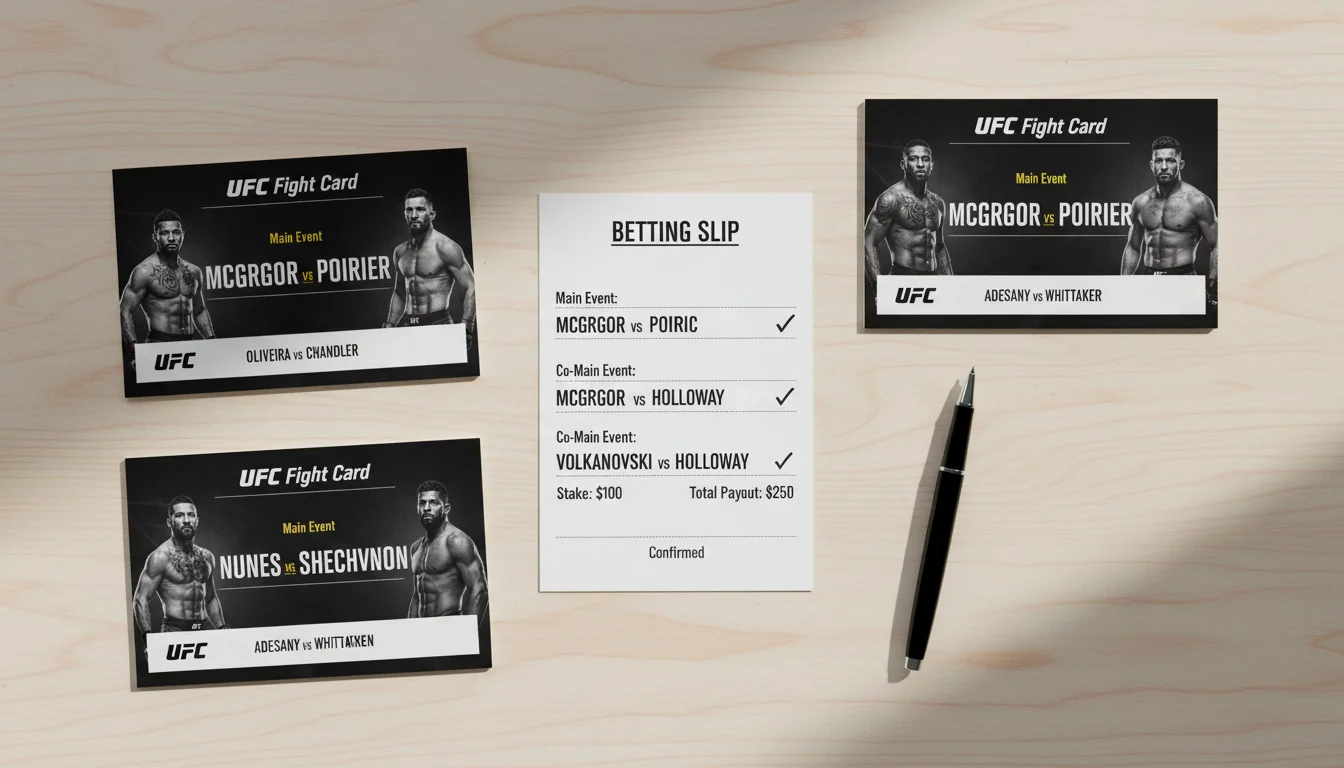
Theory is fine, but let me walk you through a real card the way I actually process it on a Saturday morning before the fights start. I will use hypothetical fighters and odds to keep this clean, but the method is exactly what I do every event week.
Suppose the main event lists Fighter A at 2/7 and Fighter B at 3/1. Step one: I convert to implied probability. Fighter A: 7 divided by (2 plus 7) equals 77.8%. Fighter B: 1 divided by (3 plus 1) equals 25%. Total: 102.8%. The overround is just 2.8% — tight market, as expected for a main event. Step two: I strip the vig. Fighter A’s true implied probability is 77.8 divided by 102.8, roughly 75.7%. Fighter B’s is 25 divided by 102.8, roughly 24.3%. These are the numbers the market actually believes.
Step three: I check my own analysis. I have spent the week reviewing striking differentials, takedown defence rates, and footage from both fighters’ last three bouts. Nearly half of all heavyweight bouts end by knockout — 49% to be precise — so if this is a heavyweight main event, I already know that backing the favourite by decision carries extra risk. My own model puts Fighter A at 70% to win. The market says 75.7%. That means the market overvalues the favourite slightly, so the value — if any exists — sits with the underdog at 3/1.
Step four: I line shop. One bookmaker has Fighter B at 3/1 while another has him at 16/5, which is 3.20 in decimal versus 4.00. That 16/5 price offers an extra 20% on the profit if Fighter B wins. Step five: I decide whether the edge is large enough to warrant a bet. A 5% edge on an underdog at 16/5 justifies a smaller stake — maybe one unit. A 10% edge on a favourite at 4/9 might justify two units, because the higher win rate smooths out variance.
This entire process takes me about ten minutes per fight. Multiply that across a twelve-fight card and you have two hours of preparation. It sounds like a lot, but the alternative — guessing based on name recognition and gut feelings — is how people donate money to bookmakers for years without understanding why they keep losing.
Odds and Probability: Your Questions Answered
What is implied probability and how do I calculate it from UFC odds?
Implied probability is the win chance embedded in a set of odds. For fractional odds, divide the denominator by the sum of numerator and denominator. At 3/1, that is 1 divided by 4, giving 25%. For decimal odds, divide 1 by the decimal price. At 2.50, the implied probability is 40%. For American odds, the formula differs for favourites and underdogs. Negative lines: divide the absolute value by itself plus 100. Positive lines: divide 100 by the line plus 100. Always remember that the total implied probability of both fighters will exceed 100% because the bookmaker’s margin is baked in.
Why do UFC odds move in the days before a fight?
UFC odds shift because real money enters the market unevenly. Sharp bettors — professionals who wager large sums — often act early in the week, forcing bookmakers to adjust. Fight-week developments like injury reports, weight-cut problems, or camp changes also trigger movement. In roughly 23% of UFC main events, the underdog and favourite actually swap positions within 48 hours of the weigh-in. Tracking these moves helps you understand where informed money is flowing.
Which odds format do UK bookmakers use by default for UFC bets?
Most UK-licensed bookmakers display fractional odds by default on UFC markets. However, nearly all major sportsbooks allow you to switch between fractional, decimal and American formats in your account settings or directly on the bet slip. Decimal odds are useful for quick price comparisons and implied probability calculations, while American odds appear frequently in MMA media and podcasts originating from the United States.
Created by the ”how Does ufc Betting Work” editorial team.