UFC Round Betting Guide: Round of Finish, Time of Finish and Round Groups
 Available in US

The most profitable single bet I placed last year wasn’t a moneyline or a method of victory — it was a round-of-finish wager at 12/1. I’d analysed a heavyweight bout where both fighters carried serious power but faded visibly after the first five minutes of every fight in their recent records. Round two felt inevitable, and the market was offering double-digit odds on an outcome I rated closer to 20% probability. That’s the beauty of round betting: it rewards specificity, and the prices reflect how difficult most bettors find it to be specific.
Round bets are among the highest-paying single wagers available on any UFC card. They’re also among the most misunderstood. This guide breaks down the three main variants — round of finish, time of finish, and round groups — and shows you how to use divisional finish-rate data to identify where the odds are genuinely generous.
Round of Finish Bets Explained
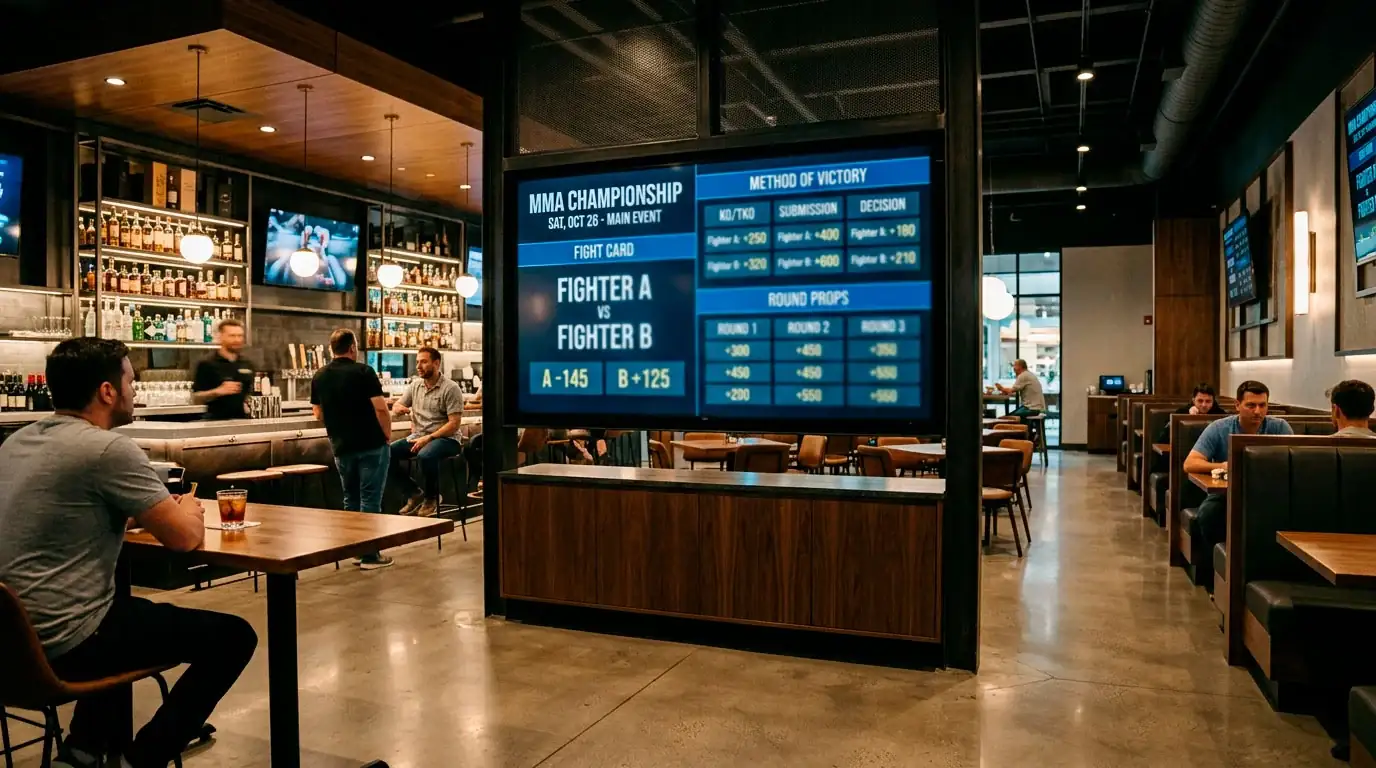
A round-of-finish bet asks you to predict the exact round in which the fight ends. Not who wins, not how — just when. If you back “round two finish” and the fight is stopped at any point during the second round, by either fighter, by any method, your bet wins. The simplicity of the proposition belies its difficulty: you’re trying to narrow a fight’s conclusion to a five-minute window.
Nearly half of all heavyweight bouts — 49% — end by KO/TKO, and only 28.6% of fights in that division reach the judges’ scorecards. Those numbers tell you something immediately useful: in heavyweight, a round-of-finish bet is inherently more viable than in a lighter division where most fights go the distance. The base probability of any finish occurring is high enough that your job shifts from “will there be a finish?” to “which round is most likely?”
Pricing on round-of-finish markets typically starts around 5/1 for the most likely round and extends to 20/1 or beyond for later rounds in three-round fights. In five-round main events, the later rounds often carry some of the best value because the market underestimates how often fatigued fighters get finished in championship rounds. My records show that rounds four and five in five-round fights produce finishes at a rate that’s consistently underpriced relative to the odds offered.
The key analytical input is each fighter’s historical finishing pattern. Some fighters are fast starters who either win early or settle into a rhythm — their round-one and round-two finish rates will be disproportionately high. Others are slow starters who build pressure and break opponents down in the middle rounds. Mapping these tendencies against the opponent’s durability profile gives you a probability distribution across rounds that you can compare directly to the bookmaker’s prices.
One pattern I’ve noticed across hundreds of cards: the market consistently overprices round one in fights between experienced fighters and underprices rounds two and three. Experienced fighters tend to feel each other out in the opening minutes, and the genuine danger escalates once they’ve gathered information. If both fighters in a bout have low first-round finish rates but high overall finishing rates, the middle rounds represent a statistical sweet spot that’s often priced generously.
Time of Finish Props
Time-of-finish bets take the specificity one step further. Instead of predicting the round, you’re predicting a time window within a round — typically broken into 2.5-minute halves. “Finish in round two, 2:31-5:00” is a time-of-finish prop, and it pays substantially more than a standard round-of-finish bet because the window is half as wide.
I’ll be honest: I use time-of-finish bets rarely, and only in situations where the data is unusually clear. The additional specificity doubles the difficulty without always doubling the payout, which means the expected value is often worse than a broader round-of-finish selection. The exception is when a fighter has an extremely concentrated finishing pattern — a striker who lands the kill shot consistently in the final ninety seconds of rounds, for instance, or a grappler who locks in submissions during the opening scrambles.
The practical value of time-of-finish markets, even when you’re not betting them, is as a calibration tool. If the bookmaker is offering 6/1 on a first-half-of-round-one finish and 8/1 on a second-half-of-round-one finish, that pricing tells you the market expects early action but considers a finish slightly more likely once the fighters have engaged. That information can refine your round-of-finish bets even if you never place a time-of-finish wager directly.
Round Group Betting
Round group bets represent the middle ground between a round-of-finish wager and a standard over/under. Instead of picking an exact round, you select a group — typically “rounds one to two” or “rounds three to five” in a main event. The payout is lower than an exact round pick but substantially higher than a moneyline or over/under bet, and the wider window gives you more margin for error.
I find round groups most useful for fights where I have a strong view on the timing but less confidence in the exact round. If I believe a fight will be stopped in the first half — the first two rounds of a five-round fight or the first round of a three-round fight — a round group bet lets me express that view without gambling on a single five-minute window. The overall UFC finish rate of 53% means that more than half of all fights produce a result before the scorecards, and concentrating that probability into a specific portion of the fight is where round groups shine.
The pricing on round groups is typically tighter than on exact rounds, which makes sense — the bookmaker is offering a wider target and adjusting the odds accordingly. In my experience, round groups offer the best value in five-round fights where the favourite is expected to win by stoppage but the timing is uncertain. “Fighter A to win in rounds one to three” at 5/4 can be a better bet than the moneyline at 1/3, because it offers nearly five times the profit margin while only excluding the scenario where the favourite wins in the championship rounds or by decision.
Using Finish-Rate Data for Round Bets
Ariel Emanuel, TKO’s executive chair, described the business as “extremely well positioned” heading into 2026 — and part of that positioning is the UFC’s commitment to action-packed matchmaking that naturally produces finishes. For round bettors, the data behind those finishes is the most valuable resource available.
Start with the divisional baseline. If you’re analysing a heavyweight fight, you know that 49% of bouts end by KO/TKO and the total finish rate is well above 70%. That high baseline makes round betting inherently more viable — you’re predicting the timing of an outcome that’s statistically likely to occur. In women’s strawweight, where 66.9% of fights go to decision, round bets are structurally less attractive because the most probable outcome is one that eliminates your bet entirely.
Layer individual fighter data on top of the divisional numbers. A fighter’s average fight time, finishing rate, and round-by-round output pattern create a more granular picture than the division-level averages alone. Two heavyweights with first-round knockout power produce a very different round distribution than two heavyweights who grind through three rounds of clinch work. The division tells you whether round betting is viable; the individual fighters tell you which round to target.
Cross-reference with the opponent’s durability. A fighter with a 70% finishing rate facing someone who has never been stopped is a fundamentally different proposition than the same finisher facing someone who’s been knocked out three times. Durability data doesn’t predict who wins, but it dramatically affects when a fight is likely to end — and selecting the right UFC bet type means matching your analysis to the market that best captures it.
Finally, track your round bets separately from your other wagers. The variance on round betting is inherently higher than on moneylines or method of victory — you’ll experience longer losing streaks interspersed with larger individual wins. Over a meaningful sample size, a positive edge in round selection will manifest, but only if you’re keeping honest records and resisting the temptation to increase stakes after a losing run. Discipline is what transforms round betting from a lottery into a strategy.
What is the difference between ’round of finish’ and ‘time of finish’ in UFC betting?
A round-of-finish bet requires you to predict the exact round in which the fight ends, but not the specific time within that round. A time-of-finish bet narrows the window further, asking you to predict a time segment within a specific round — typically the first or second half. Time-of-finish bets pay more than round-of-finish bets because the prediction window is narrower, but they are correspondingly harder to hit.
Are round bets available for three-round UFC fights?
Yes. UK bookmakers offer round-of-finish markets for both three-round and five-round UFC bouts. Three-round fights have fewer round options to select from, which means each individual round carries a higher probability than in a five-round fight. Round group bets are also available for three-round fights, though the groups are naturally smaller — typically ’round one’ versus ’rounds two to three’ rather than the wider groupings available for five-round main events.
Prepared by the how Does ufc Betting Work editorial staff.