UFC Parlay Betting: How Accumulators Work and When to Use Them
 Available in US
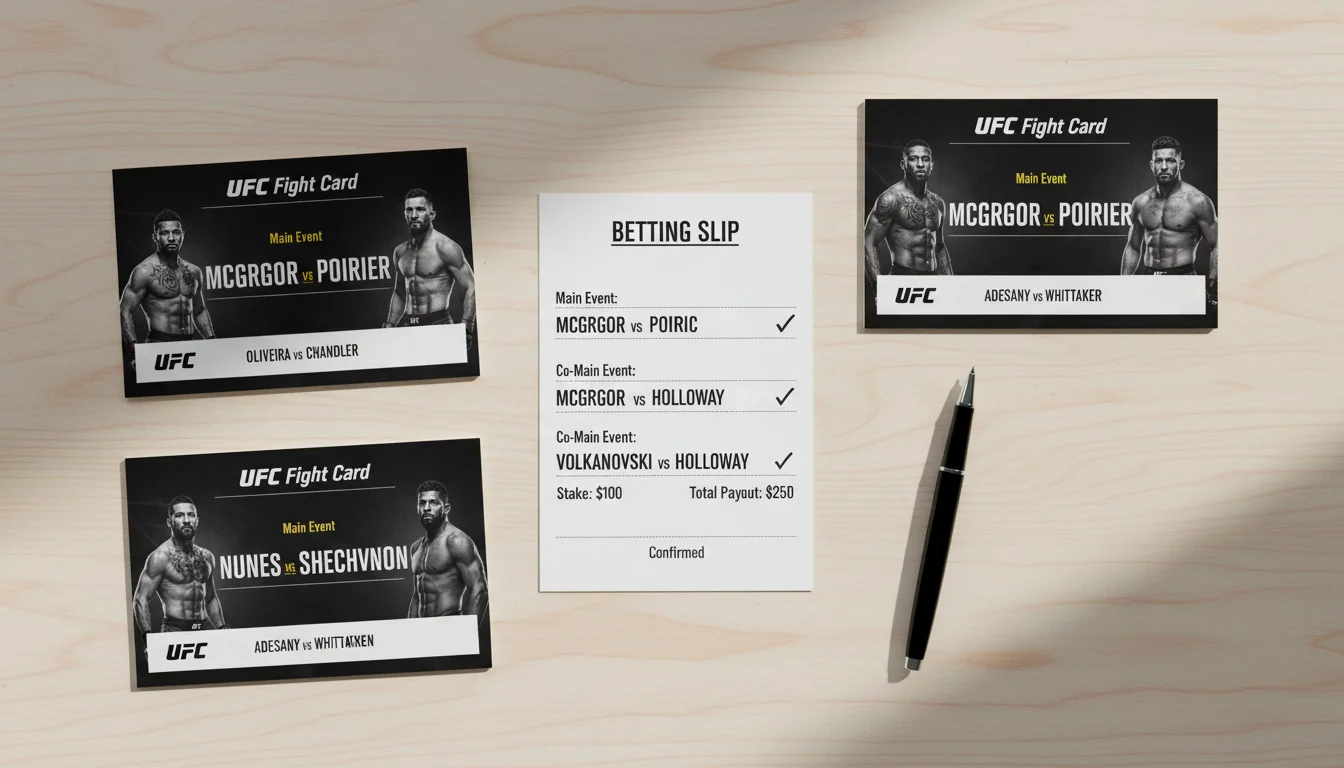
Let me tell you about the best night I ever had with a UFC parlay — and why it taught me to be more cautious, not less. Three legs, all favourites in the 1/3 to 1/2 range, combined into an accumulator that paid out at roughly 3/1. Every fighter won. I collected a tidy profit and felt like a genius. Then I ran the numbers properly the next morning and realised that if I’d placed those three bets individually over the course of a season, the expected return was actually higher than the parlay payout. The bookmaker’s margin had compounded across all three legs, and my “winning” accumulator had delivered less value than three separate moneyline bets would have.
That’s the fundamental tension with UFC parlays: they feel exciting, they offer bigger headline payouts, and they’re the single most popular bet type promoted by bookmakers on social media. They’re also mathematically designed to favour the house more than any individual bet. This guide explains exactly how UFC accumulators work, where the expected-value trap lies, and the narrow set of circumstances where a parlay can genuinely make strategic sense.
How a UFC Parlay (Accumulator) Works
A parlay — called an accumulator or “acca” at most UK bookmakers — combines two or more individual bets into a single wager. Every selection must win for the parlay to pay out. Miss one leg and the entire bet loses, regardless of how many other selections were correct.
The payout is calculated by multiplying the decimal odds of each leg together, then applying that combined multiplier to your stake. If you back three fighters at decimal odds of 1.33, 1.50, and 1.67, the combined multiplier is 1.33 x 1.50 x 1.67 = 3.33. A ten-pound stake returns 33.30 pounds — 23.30 in profit. Those same three bets placed individually at ten pounds each would cost thirty pounds total and return approximately 31.50 if all three win, meaning the parlay offers a slightly better return on a smaller outlay.
That efficiency is what makes parlays attractive. You can express multiple opinions on a single card with a single, smaller stake. But the efficiency comes at a cost: each additional leg multiplies the bookmaker’s margin alongside the odds. On a two-leg parlay, the vig compounds once. On a five-leg parlay, it compounds four times. By the time you reach a five or six-leg accumulator, you’re giving the bookmaker a double-digit percentage edge before the fights even begin.
Mark Shapiro, TKO’s president, described 2025 as a milestone year with record-setting live events and transformational partnerships — and that growth in UFC’s profile has driven a surge in parlay betting specifically. Bookmakers actively encourage accumulators because the compounded margin means parlays are the most profitable bet type for the house. That’s not a conspiracy theory; it’s arithmetic.
The practical mechanics at UK bookmakers are straightforward. Navigate to the UFC section, add multiple selections to your bet slip, and the accumulator option appears automatically. Most platforms will show you the potential payout before you confirm, and many offer “bet builder” or “same-game parlay” features that let you combine selections from within a single fight.
Same-Game Parlays in UFC
Same-game parlays — combining multiple bet types on a single bout — have exploded in popularity since bookmakers started offering them for UFC events. A typical same-game parlay might combine Fighter A to win, the fight to end by KO/TKO, and the finish to come in rounds one or two. Each leg adds to the payout, but also adds another condition that must be met.
The appeal is obvious: if you’ve done deep analysis on a specific fight and you’re confident about multiple dimensions of the outcome, a same-game parlay lets you monetise that conviction more aggressively than any single bet. But the correlation between legs is where things get tricky. Fighter A winning and the fight ending by KO/TKO aren’t independent events — if Fighter A is the bigger puncher, those outcomes are positively correlated, meaning the true combined probability is higher than the product of the individual probabilities suggests.
Bookmakers adjust the pricing on same-game parlays to account for correlation, but the adjustments aren’t always precise. In some cases, the correlated legs are priced more generously than they should be; in others, the bookmaker over-corrects. The edge, if one exists, lies in identifying where the correlation adjustment is wrong — but that requires a sophisticated understanding of the fight dynamics, not just a hunch that your fighter will win by stoppage.
I treat same-game parlays as entertainment bets with an analytical framework. If I’m going to build one, I make sure the legs are logically consistent — backing a wrestler to win by decision in rounds four or five, for instance, rather than mixing contradictory outcomes. And I never stake more than I’d be comfortable losing entirely, because the all-or-nothing structure means losses are binary.
The Expected-Value Problem With Parlays
Here’s where I have to be direct, even though it’s not what most punters want to hear. Favourites won 72% of UFC fights in 2024. That sounds reliable. But a three-leg parlay of fighters each with a 72% win probability has a combined probability of just 37.3% (0.72 x 0.72 x 0.72). Extend to four legs and you’re down to 26.9%. Five legs: 19.3%. You’ve taken three individually likely outcomes and combined them into something that fails more often than it succeeds.
The payout increases to compensate for that lower probability, but the compounding vig erodes the compensation. Each leg’s margin stacks on top of the previous one. A two-leg parlay might carry an effective house edge of 8-10%. A four-leg parlay can push past 15%. The longer the accumulator, the more the mathematical deck is stacked against you.
This doesn’t mean parlays never win. They do, regularly — that’s how bookmakers keep people placing them. But over a large enough sample, the expected value of a parlay is lower than the expected value of the same selections placed individually. The house edge is higher, the variance is higher, and the bankroll impact of a losing streak is more severe because you’re losing your entire stake on every unsuccessful accumulator.
The one legitimate mathematical argument for parlays is capital efficiency. If your total bankroll is small and you want exposure to multiple outcomes without placing multiple individual bets, an accumulator lets you do that with a single, smaller stake. The trade-off is that you’re accepting worse expected value in exchange for a higher potential payout on a lower investment. That’s a valid choice, as long as you make it consciously rather than chasing the dream of a massive payout.
When a UFC Parlay Can Make Sense
Despite everything I’ve just said about the mathematics, there are situations where I do use parlays. They’re specific, they’re infrequent, and they’re always built with a clear rationale rather than a gut feeling.
The first scenario is correlated selections that the bookmaker has underpriced. If two fights on a card share a structural similarity — both are stylistic mismatches favouring the grappler in divisions with low finishing rates, for example — the correlation between those outcomes may create a parlay that’s priced more generously than the true combined probability warrants. These opportunities are rare, but they exist.
The second scenario is short-priced favourites that offer almost no value individually. A fighter at 1/7 returns barely more than your stake, but combining two or three selections in that range can produce a payout that makes the wager worthwhile. The risk is that you’re combining events that are individually very likely but collectively less reliable than they appear — the compounding probability problem I described above. I only do this when I’ve assessed each fighter independently and believe the true win probability exceeds the implied probability by a meaningful margin.
The third scenario is pure entertainment. A big UFC pay-per-view event, a small stake, a five-leg accumulator built around fighters I’ve analysed but wouldn’t back individually at the prices offered. The potential payout is exciting, the stake is money I’ve already mentally written off, and the enjoyment of sweating five fights with a rooting interest has its own value. I never confuse this with a strategic bet — it’s a night out at the fights with a ticket that might pay for itself.
What I never do is build parlays as a default strategy. The range of UFC bet types available gives you enough options to express complex opinions without resorting to accumulators. Method of victory, round betting, and prop bets can all deliver enhanced payouts on individual fights without the compounding margin problem that makes parlays structurally inferior over time.
Building Accumulators That Respect the Odds
If you’re going to use UFC parlays — and most bettors will, regardless of the mathematics — there are principles that limit the damage. Keep accumulators to two or three legs. Every leg beyond three accelerates the vig compounding without proportionally increasing your analytical edge. Two-leg parlays carry the smallest additional margin over individual bets and give you the best risk-reward ratio within the accumulator structure.
Never include a leg you wouldn’t bet on individually. This sounds obvious, but it’s the most common parlay mistake I see. People add a “banker” — a heavy favourite they haven’t actually analysed — to pad out an accumulator. That banker carries its own upset risk, and adding it without genuine conviction turns your well-researched selections into hostages of a lazy addition.
Size your parlay stakes as a fraction of what you’d stake on an individual bet. If your standard moneyline bet is two percent of your bankroll, a parlay should be half a percent or less. The higher variance of accumulators means you need to absorb longer losing runs before the winning ones materialise, and oversizing parlay stakes relative to your bankroll is one of the fastest paths to going bust.
Record every parlay you place and track results honestly. After a few months of data, calculate your actual return against what you’d have earned placing the same selections as individual bets. The numbers will tell you whether parlays are adding value to your approach or simply adding excitement at a mathematical cost. In my experience, the answer is almost always the latter — but your data might reveal a genuine edge in specific parlay structures that works for your analytical style.
How many legs should a UFC parlay have to remain profitable?
Two to three legs is the practical maximum for maintaining a reasonable expected value. Each additional leg compounds the bookmaker’s margin, so a four-leg parlay carries a substantially higher house edge than four individual bets. Professional and semi-professional UFC bettors rarely use parlays with more than three selections, and many avoid them entirely in favour of individual wagers with cleaner expected-value profiles.
What is a same-game parlay and do UK bookmakers offer it for UFC?
A same-game parlay combines multiple bet types on a single UFC bout — for example, Fighter A to win, the fight to end by KO/TKO, and the stoppage to come in round one. Most major UK bookmakers now offer same-game parlay or bet-builder functionality for UFC events, though the available combinations and pricing adjustments vary between operators. The key consideration is that the legs are often correlated, meaning the bookmaker adjusts the odds to account for the relationship between outcomes.
Published by the how Does ufc Betting Work team.