Every UFC Bet Type Explained: Method of Victory, Over/Under, Props and More
 Available in US
Table of Contents
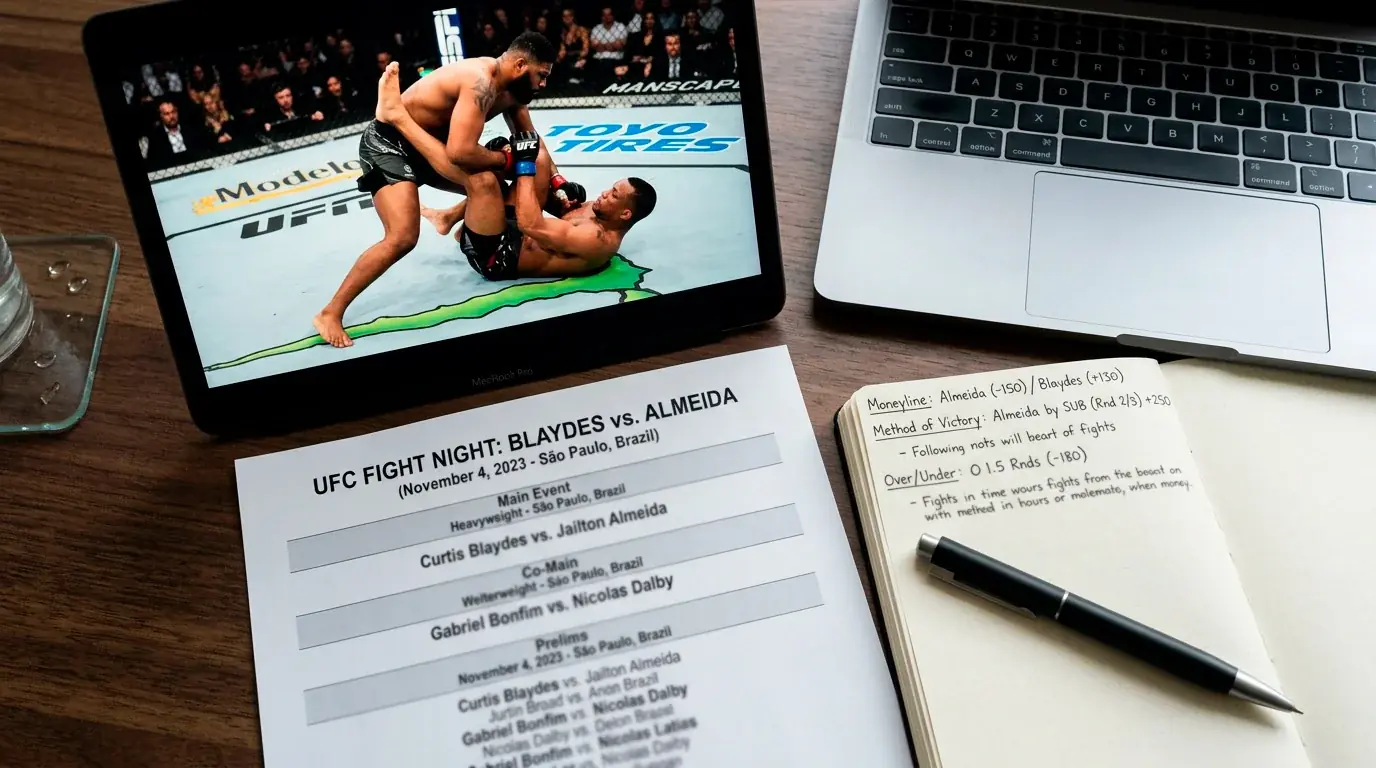
My first ever UFC bet was a moneyline pick on a main event favourite. He won by submission in the second round, I collected my modest profit, and I thought I had the whole game figured out. It took me about three months — and a lot of lost bets — to realise that the moneyline was only one tool in a toolbox full of sharper instruments. The real money in UFC betting sits in the markets most casual punters never bother to explore.
UFC fight cards offer a wider variety of bet types than almost any other sport. A single bout can generate a dozen different markets: who wins, how they win, when they win, whether the fight goes to the judges, and a string of increasingly specific propositions that reward deep fight knowledge. About 45% of UFC bouts end by knockout or TKO, 25% by submission, and 30% by decision — and each of those outcomes maps onto a different bet type with its own risk-reward profile.
This guide breaks down every major UFC bet type available at UK bookmakers, explains when each one offers genuine value, and flags the traps that catch beginners. If you need a refresher on how odds work across the three main formats, the UFC betting odds explained guide covers that ground. Here, I am focused purely on what you can bet on and why you might choose one market over another.
Moneyline (Match Winner) Bets
The moneyline is the foundation of UFC betting. You pick which fighter wins. That is it. No conditions, no time limits, no finish method — just the winner. Favourites won 72% of UFC fights in 2024, which makes the moneyline a tempting market for people who like backing the expected outcome. But here is the thing: a 72% win rate does not guarantee profit if the odds on those favourites are too short to cover the 28% of the time they lose.
A moneyline bet pays out regardless of how the victory happens. Your fighter could land a head kick in the first ten seconds or grind out a split decision after fifteen minutes — the result is the same on your slip. That simplicity is the moneyline’s greatest strength and its biggest trap. Because it feels easy, people over-bet favourites without checking whether the price actually offers value.
When I use the moneyline, it is almost always in one of two scenarios. First, when I have strong conviction on a favourite whose price has drifted due to public money moving the other way — a favourite at 4/6 who I believe should be 1/3. Second, when I spot an underdog whose odds are wider than my analysis suggests they should be. In both cases, the moneyline is my vehicle for expressing a pure directional opinion on the fight.
Where the moneyline falls short is in situations where you have a strong read on how a fight ends but not necessarily who wins. If you believe a bout is going to the scorecards but you are only slightly favouring one fighter, the moneyline forces you to take thin odds on a marginal edge. That is when the other bet types start earning their place.
Method of Victory: KO/TKO, Submission or Decision
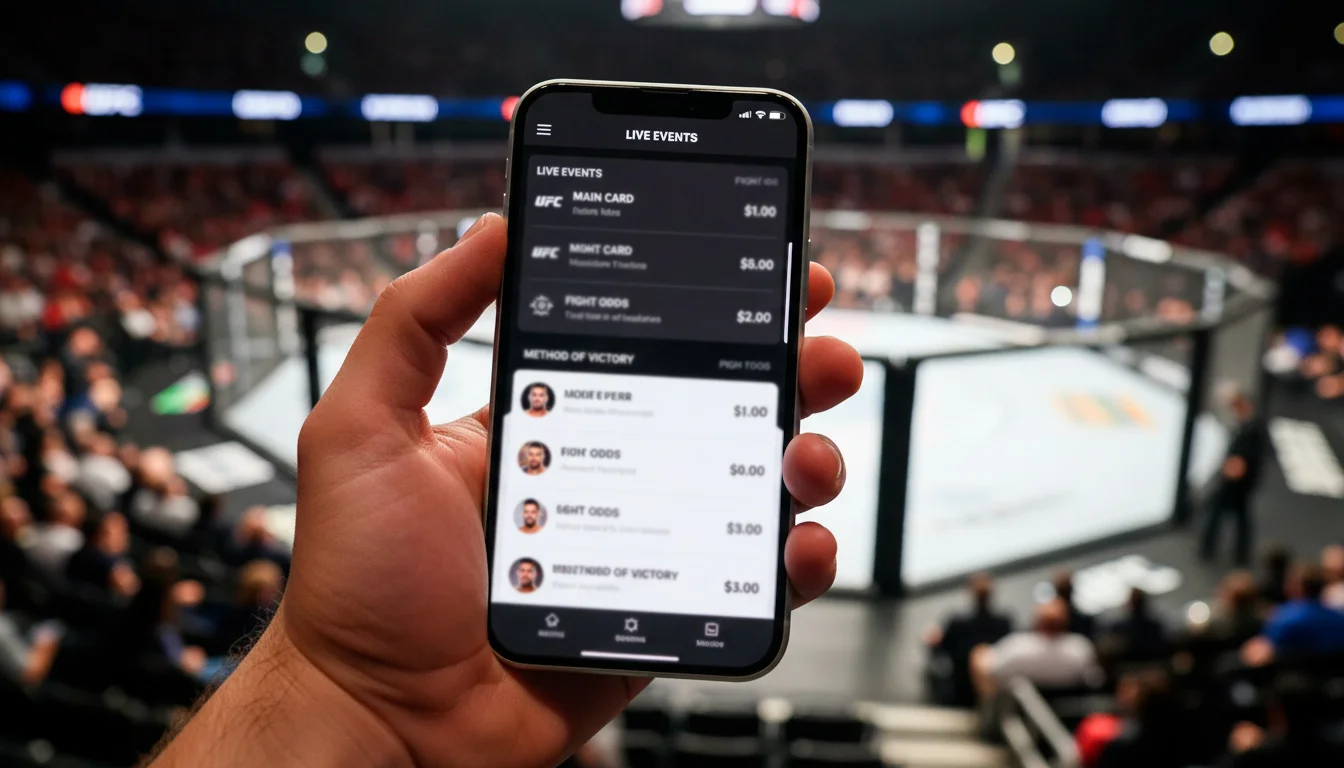
Method of victory bets are where fight knowledge really starts paying dividends. Instead of just picking a winner, you predict how they win: by KO/TKO, by submission, or by decision. Some bookmakers split this further, offering “Fighter A by KO/TKO” as one option and “Fighter B by submission” as another, creating a grid of six or more possible outcomes.
The odds on method of victory are naturally longer than the moneyline because you are making a more specific prediction. If Fighter A is 1/2 on the moneyline, “Fighter A by KO/TKO” might be 6/4 and “Fighter A by Decision” might be 7/2. You are being compensated for the additional precision — and that compensation can be substantial when your fight analysis points to a specific finish type.
I lean on method of victory markets heavily in mismatches. When a powerful striker faces a fighter with poor takedown defence, the knockout route is obvious — but so is the price, which is often hammered down by public money. The value sometimes hides in the less obvious method. A wrestler might be expected to dominate on the ground, but if his opponent has dangerous submission skills off his back, “Fighter B by submission” at 8/1 can represent far more value than anyone expects.
The overall UFC finish rate sits at 53%, meaning just over half of all fights end before the judges’ scorecards are needed. That baseline number is your starting point, but the real edge comes from drilling into division-specific data and individual fighter tendencies. A fighter who has finished four of his last five opponents tells you something very different from a fighter who has gone to the scorecards in three straight bouts.
Finish Rates by Weight Class
Weight class data transforms method of victory betting from guesswork into analysis. Nearly half of all heavyweight bouts — 49% — end by KO/TKO, making it the most knockout-heavy division in the UFC. Only 28.6% of heavyweight fights reach the judges’ scorecards. At the opposite end of the scale, women’s strawweight sees just 13.4% of fights end by KO/TKO while 66.9% go to decision.
These numbers are not just trivia. They fundamentally change which bet types offer value in each division. Backing “by KO/TKO” at heavyweight is almost a coin flip for the finish method alone, so the odds tend to be relatively short. But in lighter divisions where knockouts are rarer, a KO/TKO finish carries longer odds — and when you identify a rare power puncher competing at flyweight or bantamweight, those inflated odds can deliver outsized returns.
Submission rates tell their own story. The overall submission rate in the UFC hovers around 20% and has been declining over the years as fighters become more well-rounded and harder to catch. Chokes — particularly rear-naked chokes and guillotines — remain the most common submission type. If you are looking at a bout where one fighter has elite grappling credentials and the other has a history of giving up neck submissions, the “by submission” line is where your edge probably lives.
I keep a personal spreadsheet tracking finish rates by division, updated after each event. It takes ten minutes per card to maintain and it gives me a statistical baseline that most casual bettors simply do not have. When a bookmaker prices “by Decision” at 5/2 in a heavyweight bout where the historical decision rate is under 30%, I can immediately see whether the market is offering fair value or not.
Over/Under (Total) Rounds
Over/under rounds is the UFC equivalent of the total goals market in football. The bookmaker sets a line — usually 1.5 or 2.5 rounds for a three-round fight, or 2.5, 3.5 or 4.5 for a five-round championship bout — and you bet whether the fight finishes before or after that threshold.
Last year I had a beautiful run on under 1.5 rounds in heavyweight bouts. The logic was simple: two big punchers, both with knockout power, both historically aggressive in the first round. The market priced the under at around 5/2 because over 1.5 was the “safer” option, but the fight data told a different story. When both fighters have knockout rates above 60%, the first round is a minefield.
The key to over/under betting is understanding what the line actually represents. At 2.5 rounds, the “over” wins if the fight is still going at the halfway point of round three (two minutes and thirty seconds into the third). The “under” wins if a finish occurs before that mark. Some bookmakers offer half-round lines at 1.5, 2.5, 3.5 and 4.5, while others use a fixed 2.5 line for most fights. Check your bookmaker’s exact rules because the placement of that line changes the entire value proposition.
Over/under is particularly useful when you have a strong opinion about fight duration but no confidence in the winner. Two grapplers known for exhausting clinch wars? Over 2.5 might be the play regardless of who gets the nod. A knockout artist facing a fighter coming off two consecutive first-round losses? Under 1.5 becomes very attractive. You are betting on the nature of the fight, not the outcome, and that distinction opens up angles that the moneyline simply cannot reach.
Round Betting and Round Groups
Round betting narrows the prediction further. Instead of just picking over or under a total, you are selecting the specific round in which the fight ends — or, in some markets, the specific round in which a particular fighter gets the finish. The odds are longer because the prediction is more precise, and the payouts reflect it.
Most UK bookmakers offer “round of finish” betting, where you choose Round 1, Round 2, Round 3, and so on. Some also offer “round group” betting, which bundles rounds together: Rounds 1-2, Rounds 3-4, or Rounds 4-5. Round groups reduce the precision required while still paying better than a straight over/under. If your analysis says a fight will end in the second or third round but you cannot narrow it down further, a round group bet lets you express that view without committing to a single five-minute window.
“Time of finish” is the most granular version. Here you predict the exact minute within a round when the stoppage occurs. I rarely touch this market because the precision required is extreme and the odds, while long, do not compensate enough for the near-random nature of exact timing. The exception is fights where one fighter has a pattern of early stoppages — three first-round knockouts in the first two minutes, for instance. Patterns like that can make time-of-finish props genuinely profitable.
Round betting works best when combined with divisional data. If you know that a specific weight class produces first-round finishes at twice the rate of the division above it, your round bet allocation should reflect that. It is not about predicting the future with magical precision; it is about understanding where the probabilities cluster and finding prices that overestimate the outlier outcomes.
Prop Bets and Specials
Prop bets — short for proposition bets — are the wild west of UFC betting. They cover anything that does not fit neatly into the moneyline, method of victory, or round betting categories. Will there be a knockdown? Will the fight go to the scorecards? Will either fighter attempt a takedown in round one? The specificity varies wildly, and so does the value.
UK bookmakers typically offer a smaller prop menu than their American counterparts, but the selection has grown significantly since 2024. You can now find fight-specific props on most main card bouts, including total knockdowns, total takedowns, and whether a specific fighter will be deducted a point. These niche markets attract less volume than the moneyline, which means the odds are set by fewer people and are more likely to contain pricing errors you can exploit.
My favourite prop markets are the ones tied to specific fighter tendencies. If a fighter averages 4.2 significant strikes per minute and his opponent absorbs strikes at a high rate with poor head movement, “over X total significant strikes” becomes a data-driven bet rather than a speculative punt. Props reward the kind of granular statistical knowledge that moneyline bettors never need to develop — and that is precisely why they tend to offer better value to those willing to do the work.
“Goes the Distance” and Fight-Length Props
“Goes the distance” is a yes/no proposition: will the fight last the full scheduled rounds and go to the judges’ scorecards? It strips away all the complexity of picking a winner or a method and focuses on a single question — does this fight end early or not?
I use this market more than most people expect. When two elite grapplers with excellent chins are matched up, the “yes” side often pays plus money despite the fight having a strong probability of reaching the scorecards. Conversely, when two reckless brawlers collide, the “no” side might be priced as a heavy favourite — which sometimes means the “yes” price has drifted to the point of offering genuine value for a low-probability outcome.
The “goes the distance” prop also serves as a hedge. If you have backed Fighter A on the moneyline but you are worried about a late finish that might go the wrong way, a small bet on “No — does not go the distance” with Fighter B by KO/TKO can offset some of your risk. It is not a strategy for every fight, but on high-stakes cards where I am overexposed to one side, this prop gives me a pressure valve.
Parlays (Accumulators) and Same-Game Multis
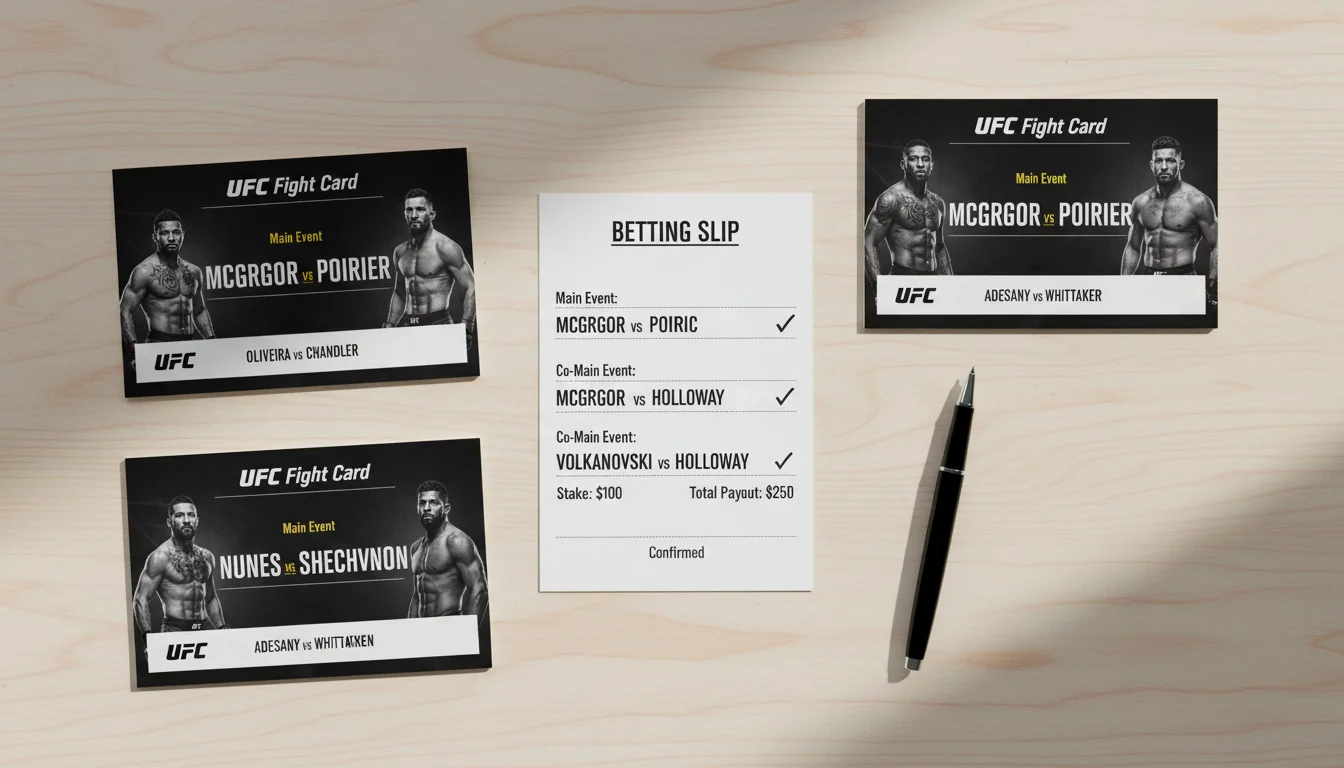
A parlay — known as an accumulator or “acca” in the UK — combines two or more bets into a single wager where every selection must win for the bet to pay out. The appeal is obvious: the odds multiply together, so a three-leg parlay of 2/1, 3/1 and 4/1 pays out at a combined price that dwarfs any individual bet. The risk is equally obvious: one wrong pick and the entire ticket is dead.
Nicholas Smith, SVP of global partnerships at TKO, described bet365 as understanding “fight fans and how they engage with the sport in real time.” That engagement increasingly includes same-game parlays, where you combine multiple markets from a single UFC bout — say, Fighter A to win by KO/TKO in rounds 1 or 2. These same-game multis have become wildly popular because they let you stack correlated outcomes into a single high-odds ticket.
Here is my honest take on parlays after nine years of UFC betting: they are entertainment products, not investment vehicles. The bookmaker’s margin compounds with each leg you add. A single bet with a 5% overround becomes a three-leg parlay with an effective overround of roughly 15%. The expected value of most parlays is deeply negative, and the variance is brutal. I have seen people hit five-leg accumulators and convince themselves they have found a system, only to lose it all back over the following month.
That said, I do use parlays in narrow circumstances. When a card features two or three fights where my edge is significant but the individual prices are too short to justify a flat bet — two favourites at 1/3 each, for instance — a small parlay lets me combine those edges into a payout that justifies the stake. The key is discipline: never more than three legs, never with money I cannot afford to lose, and never as a substitute for proper bankroll management.
Futures and Outright Bets
Futures bets are long-term wagers on outcomes that will not be settled for weeks or months. In UFC terms, that usually means betting on who will hold a specific championship belt by a certain date or who will win a tournament bracket. These markets open months before the event and the odds shift as fights are booked, cancelled, and completed.
The attraction of futures is the price. Backing a challenger at 10/1 to hold the lightweight title by December offers a massive payout if your analysis proves correct. The downside is that your money is locked up for the entire duration of the bet, and any number of things can go wrong: injuries, failed drug tests, opponent changes, or simply a bad performance on the night.
I take one or two futures positions per year, usually when a divisional shakeup creates a clear path for a fighter the market has not yet adjusted to. If a dominant champion retires or vacates and the next title fight is between two fighters I know well, the futures market often lags behind the news cycle. That lag is where value appears — briefly, before the sharps correct it.
Point Spreads in UFC: Do They Exist?
If you come from football or basketball betting, you might be wondering where the point spread is. In those sports, the spread is the default market — the bookmaker handicaps the favourite by a set number of points to level the playing field. UFC does not lend itself to this model nearly as well, but point spreads do exist in a limited form at some bookmakers.
UFC point spreads are based on the official scorecards. A fighter might be listed at -3.5, meaning they need to win by more than 3.5 points on the judges’ scorecards for the spread bet to pay out. If the fight ends by finish, the spread is typically graded in favour of the winner with a maximum margin. The problem is that UFC scorecards use a 10-point must system where most rounds are scored 10-9, so a three-round fight that goes to decision will usually produce a margin of just one to three points. The spread market in UFC is inherently thin.
Most UK bookmakers do not offer UFC point spreads at all, and those that do typically restrict them to main event bouts with clearly defined favourites. My advice for UK punters is to treat the spread as a curiosity rather than a core betting tool. The moneyline and method of victory markets are far more liquid, far better priced, and far more applicable to the realities of how UFC fights actually play out. If you want to explore handicap wagering in combat sports, the method of victory market serves a similar purpose with better odds.
UFC Bet Types: Your Questions Answered
What is the difference between a method of victory bet and a round bet?
A method of victory bet predicts how a fight ends — KO/TKO, submission or decision — without specifying when. A round bet predicts the specific round in which the fight is stopped. Some bookmakers combine both into a single market (for example, Fighter A by KO in Round 2), but they are separate bet types at most UK sportsbooks. Method of victory is the broader prediction; round betting adds a time dimension that increases both the odds and the difficulty.
Can I combine multiple UFC bet types into one accumulator?
Yes, most UK bookmakers allow you to combine different bet types into a single accumulator. You could pair a moneyline pick from one bout with a method of victory selection from another and an over/under rounds bet from a third. Same-game parlays, which combine markets from a single fight, are also available at an increasing number of operators. Keep in mind that each added leg multiplies the bookmaker’s margin, which erodes expected value significantly.
What does ‘goes the distance’ mean in UFC betting?
‘Goes the distance’ is a yes/no proposition bet on whether a fight will last the full scheduled number of rounds and be decided by the judges. For a standard three-round bout, the fight goes the distance if it reaches the final bell after round three. For a five-round championship bout, it must reach the end of round five. This market is useful when you have a strong view on fight duration but less confidence about who actually wins.
Are point spreads available for UFC fights at UK bookmakers?
Point spreads are rarely offered for UFC fights at UK-licensed bookmakers. When they do appear, they are usually restricted to high-profile main events and are based on the official scorecard margin. The UFC’s 10-point must scoring system produces narrow margins that make spread betting less practical than in team sports. Most UK bettors find better value in moneyline, method of victory and over/under markets.
Written by the editors at how Does ufc Betting Work.